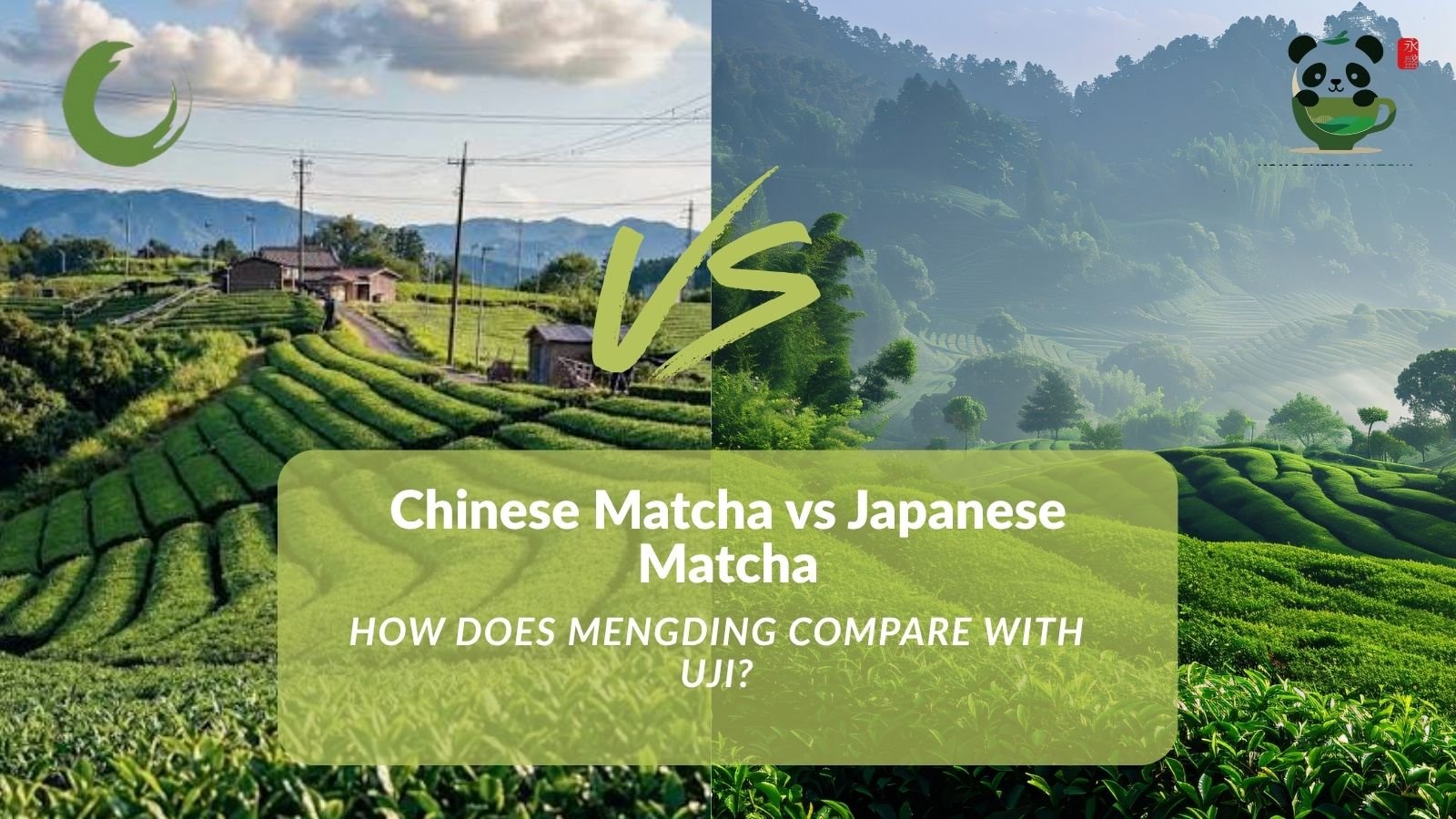
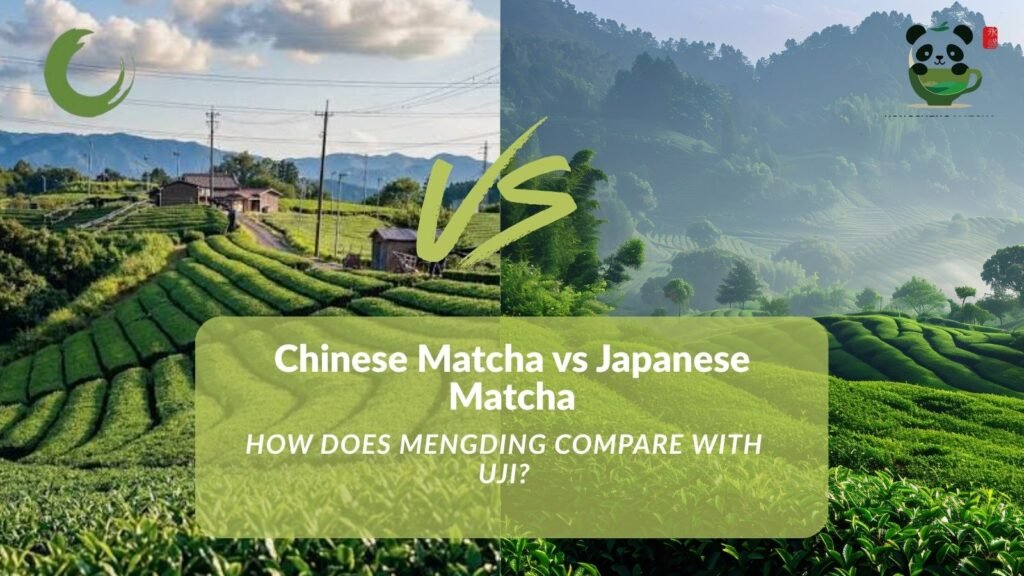
Search for China vs Japan matcha and the discussion quickly narrows to one question: which country makes better matcha? It's a fair question. Japanese matcha, especially from established regions like Uji, has earned its premium reputation through shade-grown cultivation, tencha production and centuries of tea culture. That reputation is real, and an honest comparison starts by acknowledging it.
But is "China vs. Japan" really the best way to compare matcha?
The labels "Chinese matcha" and "Japanese matcha" each cover a wide range of products, grades and production systems, and the country on the label tells you less than the region, producer and process behind the powder. Comparing two specific tea regions, Mengding and Uji, tells you more. This guide looks at both across tradition, production, price and positioning, then closes with a practical framework for choosing matcha for your business.

High-mountain gardens on Mount Mengding, Sichuan, at approximately 800 to 1,200 meters.
Chinese Matcha vs Japanese Matcha: What's the Difference?
Japanese matcha carries an established reputation for shaded cultivation, tencha production and refined tea culture. China has a much larger, increasingly modern matcha industry, but "Chinese matcha" covers a wider range of products and production methods.
That summary is broad on purpose: the two labels are not two products. One table covers most of what matters:
| Japanese Matcha | Chinese Matcha | |
|---|---|---|
| Tea tradition | Long-established matcha culture | Long tea-growing tradition, modern matcha industry developing |
| Major regions | Uji, Yame, Nishio, etc. | Mengding, Guizhou, Zhejiang, etc. |
| Cultivation | Varies; shading common for matcha | Varies by producer / product |
| Processing | Tencha-based processing common | Varies widely, from ground green tea to modern tencha-based production |
| Market position | Strong premium reputation | Broad range, from commodity to high-quality B2B |
| Price | Often higher | Often more cost-efficient |
The region names in the table deserve a closer look. In Japan, Uji in Kyoto Prefecture is the historic premium name, while Nishio in Aichi and Yame in Fukuoka are major production regions with strong processing bases. In China, the modern industry is concentrated in provinces such as Guizhou and Zhejiang, while Mengding in Sichuan brings something different: a famous tea-growing mountain with a long history, now adding modern matcha production.
Neither column is a quality verdict. Japan's reputation rests on a concentrated cluster of premium origins; China's industry spans a much wider range, from commodity powder to high-quality B2B supply. In both countries, the producer and the written specification tell you more than the country label, which is why experienced buyers compare suppliers and specs, not passports. The rest of this guide narrows the comparison to two regions: Uji in Japan and Mengding in China.
Why Uji Became the Benchmark for Japanese Matcha
For international buyers, the Uji tea region south of Kyoto is probably the best-known benchmark for premium Japanese matcha. Why Uji earned that position explains much of the China vs Japan matcha debate.
Uji has been central to Japanese tea culture for centuries. The region is closely associated with the refinement of powdered tea and with the early development of the shaded cultivation techniques that later defined matcha and gyokuro production. Tea cultivation there is traced back hundreds of years, and the region's name still carries that weight in the market.
Generations of specialized production sit behind the name: shade-grown tencha cultivation, careful steaming and drying, and slow milling into a fine, vivid powder. Shading is central to the craft. Covering the bushes for weeks before harvest changes the balance of amino acids, catechins and pigments in the developing leaf; the result is the sweeter, more savory taste and deeper green color of high-quality matcha. Much of what buyers now expect from premium Japanese matcha (deep green color, savory flavor) has been shaped by production traditions in regions like Uji.
Over time Uji built a premium origin identity that few tea regions anywhere can match, and the market pays for it. At Kyoto's first tencha auction of 2025, the average price reached ¥8,235 per kilogram, about 1.7 times the previous year's average, as reported by the Global Japanese Tea Association.
But a benchmark is not a verdict. Uji's reputation does not make every Japanese matcha better than every matcha from elsewhere, and benchmarks invite comparison.
Mengding vs Uji: Two Tea Regions, Two Traditions
Mount Mengding sits in Ya'an, in Sichuan Province in southwestern China. Traditional accounts trace cultivated tea on the mountain to 53 BC, when Wu Lizhen is credited with planting seven tea trees, and tea from the mountain later entered the imperial tribute system in the Tang dynasty. Mengding tea remained associated with imperial tribute for centuries, and the surrounding Ya'an region grew into one of China's traditional tea centers. The higher-elevation gardens on the mountain sit at roughly 800 to 1,200 meters, where frequent cloud and mist create a cool, diffuse-light environment for slow spring growth. For buyers, the region offers something rare: a 2,000-year Mengding tea heritage with a living tea culture still around it.
Like Uji, Mengding is not simply a place where tea is produced; it has its own tea history and regional identity.
Modern matcha production in Mengding combines this tea-growing environment with contemporary matcha processing. The mountain's traditional teas, such as Mengding Ganlu, remain part of local identity, but modern matcha is a distinct, younger industry built on the region's tea-growing resources. At Yongsheng, tea leaves for matcha are shaded for at least 20 days before harvest, steamed and processed into tencha, then milled on closed-loop, low-temperature automated grinding lines, with custom milling specifications available. Compared with a craft stone-mill workshop, automated lines are designed to provide higher volume and tighter control of temperature, particle size and batch-to-batch consistency, which can be important for food and beverage companies. Production runs to written specifications, with quality control and batch testing at the mill.

Tea rows at Yongsheng shaded for at least 20 days before harvest.
The comparison, then, is not between two countries but between two tea regions and two production systems:
| Mengding | Uji | |
|---|---|---|
| Heritage | Long Chinese tea history | Long Japanese tea history |
| Identity | Sichuan / Chinese tea tradition | Kyoto / Japanese tea tradition |
| Matcha development | Modern matcha industry | Centuries of established matcha production |
| Strength | Tea-growing resources + modern production | Craftsmanship + established premium reputation |
| Positioning | Emerging origin for modern matcha | Established premium origin |
Read across the rows and the pattern is clear. Both regions draw on long tea histories, but their matcha industries developed on different timelines: Uji's over centuries, Mengding's as a modern industry built on tea-growing resources and current processing technology. Uji offers craftsmanship and an established premium name. Mengding offers growing resources, modern production capacity and a fresh origin identity. A buyer sourcing ceremonial drinking matcha and a beverage chain sourcing twenty tons a year are not asking the same question, and the two regions answer them differently.
The point is not that Mengding should replace Uji. The two regions come from different tea traditions and production systems, and each answers a different buying question.
Is Japanese Matcha Actually Better?
There is no single answer, because "better" has no single meaning. Matcha whisked in a bowl, matcha shaken into milk and matcha baked into a sponge are three different products, even when the powders look similar. A powder that performs beautifully in a whisked bowl can disappear in milk, and a powder built for lattes may taste flat on its own. The honest way to compare is by application:
| If you are buying for... | What matters |
|---|---|
| Traditional tea preparation | Origin, craftsmanship, flavor complexity |
| Daily drinking | Taste + freshness + price |
| Latte | Color + flavor intensity + cost |
| Baking / desserts | Color + flavor + consistency |
| Commercial production | Consistency + testing + supply + price |
A premium Uji matcha may be the right choice for someone seeking a traditional Japanese tea experience. But for a café, bakery or food manufacturer, the "best" matcha is the one that delivers the right color, flavor, consistency and cost at scale. For those buyers, origin is one input among several, and rarely the deciding one. In practice, that means testing samples in your own milk, dough or drink before committing to a bulk order.
How to Choose Matcha Regardless of Origin
Whichever region you buy from, five questions sort strong matcha from weak:
-
Origin. Where was it actually grown? A specific region, and where possible a named producer, tells you more than a country label.
-
Raw material & cultivation. What tea material was used, and was it shaded? In traditional matcha production, the tea comes from shaded tencha, with shading often lasting around 20 days or longer. Specifications vary by producer, cultivar and market, so verify the actual cultivation and processing method.
-
Processing. How was it processed into matcha? Steaming, drying and milling methods shape color, flavor and shelf life. Ask what the process is designed for: drinking, beverages or baking.
-
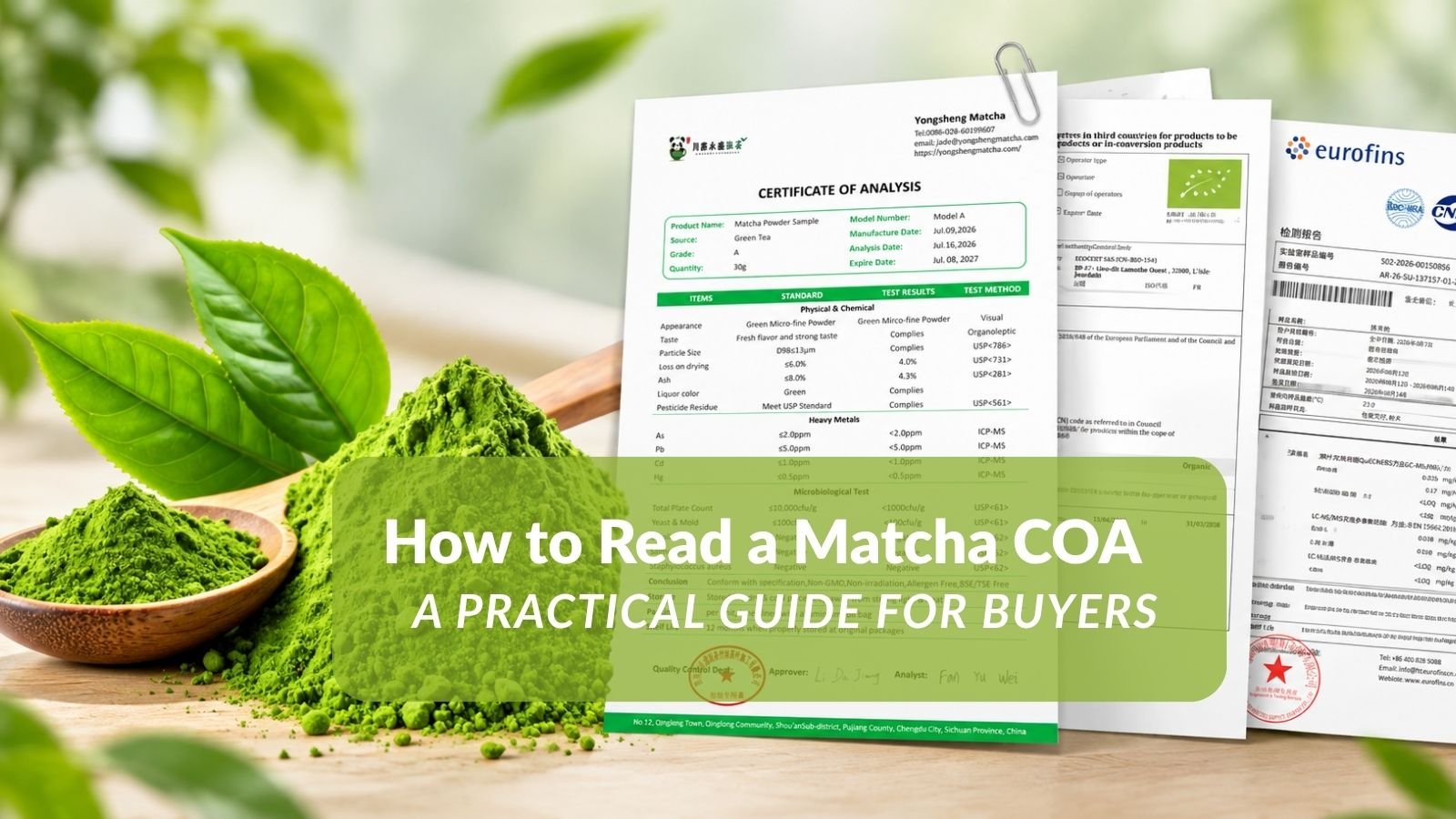
Testing & traceability. Can the supplier provide relevant testing and traceability? Batch-specific COAs and residue reports are the honest answer; a test report that cannot be tied to your lot proves nothing about your order.
-
Consistency & application. Will it perform consistently for your intended use? A supplier who can repeat the same profile batch after batch is worth more than a famous label.
Origin tells you where the matcha comes from, production tells you how it was made, testing tells you what is in the lot within the parameters tested, and application tells you whether it is the right matcha for your business.
For the full framework, including specification sheets and how to audit a COA, see our guide to evaluating a matcha supplier.
Why Consider Mengding Matcha?
If you are looking for an alternative to traditional Japanese matcha, Mengding is worth exploring.
Yongsheng Matcha grows and mills matcha in the Mount Mengding tea-growing region of Sichuan, with traceable origin from garden to lot. Supply is built for B2B: bulk volumes, consistent specifications, customization options and application support. Every batch ships with a COA, and an EU-market residue test report covering 611 items for a tested lot is available on request.

Modern matcha production in Mengding: steamed tencha processing and closed-loop, low-temperature automated milling.
Mengding is not a copy of Uji. It is a different origin, with its own tea heritage and a modern production base for today's matcha market.
Want to compare directly? Request a Match-up Sample Kit and bench-test Japanese and Mengding matcha in your own recipe: free samples of 10 to 500 g, drawn from production lots, with a reply within 12 hours.
FAQ
Is Chinese matcha real matcha?
In traditional matcha production, the tea is made from shaded leaves processed into tencha and then finely ground. Chinese producers can make matcha through the same tencha-based process, while ground unshaded green tea is generally better described as green tea powder, whatever its origin. Check the specification sheet for shading information and cultivar rather than relying on the country label.
Is Chinese matcha safe? Does it meet EU or US standards?
Food-safety compliance should be verified at the batch level, not assumed from the country of origin. Meeting the applicable requirements depends on the product, destination market and tested lot. Ask any supplier for a batch-specific COA with pesticide, heavy-metal and microbiological results, and evaluate it against your destination market's limits. The EU applies some of the strictest residue rules in the world: for pesticides without a specific EU maximum residue level, a default MRL of 0.01 mg/kg generally applies. For example, we can provide an EU-market residue test report covering 611 items for the tested lot. For the full verification framework, see our supplier evaluation guide.
Why is Japanese matcha so expensive?
Several factors contribute: strong origin reputation, constrained supply, labor-intensive cultivation and processing, and the cost of producing premium-grade tencha. Demand for Japanese matcha has grown rapidly, and premium tencha supply has come under particular pressure. Traditional stone-mill production is particularly slow, though it remains important for some premium products. At Kyoto's first tencha auction of 2025, average prices reached about 1.7 times the previous year, as reported by the Global Japanese Tea Association. Premium origin pricing reflects the whole system, not only the powder in the tin.
Can Chinese matcha be ceremonial grade?
"Ceremonial" has no legal or industry-wide definition in any country, so the word alone tells you little. Some Chinese producers use it for their top drinking grades. Judge drinking-quality matcha by color, aroma, taste, harvest information and specification sheet, not by the label.
Does Mengding matcha taste like Uji matcha?
Not necessarily, and origin alone cannot predict the cup profile. Flavor varies significantly by cultivar, shading, harvest timing and processing, so the reliable method is to taste samples in the drink or dough you actually make.