One supplier advertises bulk matcha, another sells wholesale matcha, and a third claims to offer both. The terms are often used interchangeably, but they describe different aspects of a purchase.
Bulk generally describes the quantity or packaging format. Wholesale describes the B2B purchasing relationship and pricing structure.
A purchase can be both bulk and wholesale. A café, for example, might purchase a 1 kg bag of matcha at a wholesale price. A retailer might purchase wholesale quantities of smaller, retail-ready tins.
Understanding the difference helps you choose the right supplier, order size, packaging format, and purchasing model for your business.

What Is Bulk Matcha vs Wholesale Matcha?
Bulk matcha generally refers to matcha sold in larger quantities or functional packaging intended for commercial use, rather than small consumer packages.
Depending on the supplier and application, bulk matcha may be offered in formats such as 500 g, 1 kg, or larger food-service and manufacturing packs.
Wholesale matcha refers primarily to the purchasing relationship. It is matcha sold business-to-business, typically under commercial pricing and purchasing terms for applications such as cafés, tea shops, food manufacturers, distributors, and retailers.
The two terms overlap because wholesale matcha is often supplied in bulk formats. However, they are not interchangeable:
- You can buy a bulk quantity without having a wholesale account.
- You can purchase wholesale quantities in retail-ready packaging.
- A manufacturer, distributor, or reseller can all offer bulk or wholesale matcha.
This last distinction is important. Bulk does not mean manufacturer, and wholesale does not mean reseller.
Whether a supplier is a manufacturer, distributor, importer, or reseller is a separate question from whether the product is sold in bulk or wholesale. If you are evaluating suppliers, you should verify the supplier's role and traceability separately.
For businesses purchasing matcha as an ingredient, our bulk matcha powder supplier program is designed for commercial applications. For buyers purchasing matcha for resale, see our wholesale and private label matcha options.
Wholesale vs Retail vs Bulk Matcha Pricing
It is useful to think of retail, wholesale, and bulk as overlapping concepts rather than three fixed price levels.
| Term | What it describes | Typical buyer |
|---|---|---|
| Retail | Consumer-facing sale, usually in smaller branded packages | Home consumers |
| Wholesale | B2B purchasing relationship and commercial pricing | Cafés, retailers, distributors, manufacturers |
| Bulk | Larger quantity or functional packaging | Cafés, bakeries, manufacturers, resellers |
The price difference between retail and wholesale can be significant, but there is no universal wholesale price for matcha.
The actual price depends on factors such as:
- Origin
- Cultivar
- Harvest timing
- Shading and cultivation practices
- Processing and milling
- Grade and intended application
- Order quantity
- Packaging
- Certifications and testing
- Incoterms and shipping costs
- Supplier and purchasing relationship
This is particularly important in a market where matcha raw-material costs can fluctuate. Japanese tencha prices rose significantly during the 2024–2025 supply shortage, putting additional pressure on matcha prices. For example, the Global Japanese Tea Association reported that the average price at Kyoto's first tencha auction of 2025 was ¥8,235 per kg, about 1.7 times the previous year's average.
The lesson for buyers is not that there is one "correct" price per kilogram. Instead, compare the specification, origin, documentation, and landed cost behind the price.
For cafés, a simple consumption calculation can also make bulk purchasing easier to evaluate.
For example, if a drink uses 2.5 g of matcha, then:
1 kg ÷ 2.5 g = approximately 400 drinks
This is an illustrative calculation rather than a recommended dosage. Actual dosing varies by recipe, product, and desired flavor intensity.
For milk-drink menus, our matcha for lattes line is formulated for commercial beverage applications.
How Much Matcha Should You Buy?
A simple starting point is:
Monthly matcha requirement (kg) = matcha drinks per day × operating days × grams per drink ÷ 1,000
For example, assuming 30 operating days per month and a 2 g dose:
| Matcha drinks per day | Approx. monthly requirement |
|---|---|
| 20 | 1.2 kg |
| 50 | 3 kg |
| 100 | 6 kg |
These numbers are examples, not universal consumption benchmarks. Your actual requirement will depend on your recipe, serving size, menu mix, operating schedule, and waste.
You should also account for:
- Spillage
- Recipe testing
- Staff training
- Promotions
- Seasonal demand
- Product sampling
- Inventory that cannot be used before its best-before date
In working cafés and production kitchens, these factors together typically add 5 to 10% on top of theoretical consumption, so build that buffer in when converting a monthly requirement into an actual order.
The important principle is:
Match your order quantity to your actual consumption cycle, not simply to the lowest available price tier.
A larger order may reduce the unit price, but the saving can disappear if the product sits in storage for too long or if you have to compromise on freshness and inventory turnover.
MOQ (minimum order quantity) varies considerably between suppliers. It can depend on whether you are purchasing an existing stock item, custom packaging, a private-label product, or a custom formulation.
Instead of asking only "What is your MOQ?", ask:
- What is the standard MOQ?
- Is a smaller trial order available?
- Does the MOQ change for different grades?
- Does custom packaging have a higher MOQ?
- Can different products or grades be combined into one shipment?
This gives you a much clearer picture of the supplier's actual purchasing flexibility.
Samples usually come before any trial order. Two questions worth adding: what sample sizes does the supplier offer, and are they drawn from production lots? A sample pulled from an actual production lot, with its COA, tells you whether the material you bench-test is the material a bulk order would carry.
Storage Sets the Ceiling on Order Size
Matcha is sensitive to oxygen, light, heat, moisture, and odors. Exposure to these factors can gradually affect color, aroma, flavor, and overall quality.
There is no single storage period that applies to every matcha product. Shelf life depends on the product, packaging, processing, storage conditions, and the supplier's stated best-before date.
For that reason, buyers should follow the supplier's storage instructions rather than relying on a universal "60-day" or "90-day" rule.
For commercial buyers, a practical approach is to:
- Keep unopened product in its original protective packaging where possible.
- Minimize exposure to oxygen, moisture, heat, and light.
- Avoid repeatedly opening a large container.
- Use appropriately sized airtight containers when repacking is necessary.
- Keep working quantities separate from the main inventory.
- Rotate stock according to the supplier's recommended shelf life.
The larger the order, the more important inventory turnover becomes.
If your business uses only a small amount of matcha each month, a lower MOQ and more frequent purchasing schedule may make more sense than buying a large quantity simply to obtain a lower price.
At Yongsheng Matcha, we mill against orders where applicable and maintain sealed inventory under controlled storage conditions. This allows us to manage production and storage according to customer requirements.

Retail vs Bulk Matcha Packaging
Packaging is another area where bulk and retail products commonly differ.
| Dimension | Retail packaging | Bulk packaging |
|---|---|---|
| Typical format | Tins, pouches, stick sachets | Larger bags or food-service packs |
| Design intent | Branded and shelf-ready | Functional and efficient for storage and use |
| Barrier protection | Varies by product | Often designed for stronger protection during storage and transport |
| Per-gram cost | Generally higher | Generally lower at larger quantities |
| Typical buyer | Home consumers | Cafés, bakeries, manufacturers, resellers |
However, packaging format does not determine matcha quality.
The same or similar product may be available in a small consumer tin, a food-service bag, or a larger manufacturing package.
Likewise, a large package does not automatically mean higher quality, and a small tin does not automatically mean lower quality.
When evaluating quality, look beyond the packaging and ask about:
- Origin
- Cultivar
- Harvest information
- Processing
- Milling
- Product specifications
- Testing
- Batch traceability
- Storage conditions
Terms such as "ceremonial grade" should also be treated carefully. "Ceremonial" is widely used in the market but is not a universally standardized official matcha grade.
A supplier's specification and batch documentation can therefore tell you more than a marketing label alone.

How to Compare Bulk Matcha Suppliers
Price per kilogram should be only one part of your supplier evaluation.
| Criterion | What to verify |
|---|---|
| Origin | Country, region, and available farm, harvest, and cultivar information |
| Specification | Written product specification covering the characteristics relevant to your application |
| Documents | Batch-specific COA and applicable food-safety, testing, and certification documents |
| MOQ | Standard MOQ, trial MOQ, and whether different products can be combined |
| Lead time | Production time, shipping method, and expected customs/clearance time |
| Consistency | How the supplier manages batch variation and whether production samples can be provided |
| Landed cost | Product price plus freight, duties, customs, testing, and other applicable costs |
1. Origin and Traceability
Ask where the matcha comes from and how far the supplier can trace it back through the supply chain.
Depending on the supplier, useful information may include:
- Country of origin
- Growing region
- Farm or producer
- Cultivar
- Harvest information
- Processing location
A supplier that can clearly identify these details and support them with appropriate documentation provides a stronger traceability signal than a supplier relying only on broad marketing claims.
To make this concrete, here is our own answer: Yongsheng Matcha grows and mills matcha in 100,000m² of tea gardens on Mount Mengding, Ya'an, Sichuan, at 800 to 1,200 m on the 30°N growing belt, with at least 20 days of shading before harvest. Gardens, milling, and export documents sit inside one operation, so the trail from leaf to lot COA does not cross intermediaries.

2. Product Specifications
Do not evaluate a commercial matcha only by color or price.
Ask for a written specification that is relevant to your application. Depending on the product, this may include:
- Particle-size information
- Color measurements
- Caffeine or theanine information
- Microbiological limits
- Heavy-metal limits
- Pesticide requirements
- Other application-specific specifications
Not every supplier will provide every measurement, and not every measurement is necessary for every application. The important point is to establish written specifications that match your intended market and use.
3. Batch Documents and Certifications
For commercial purchasing, ask whether the supplier can provide documentation tied to the actual production lot.
Depending on the destination market and application, this may include:
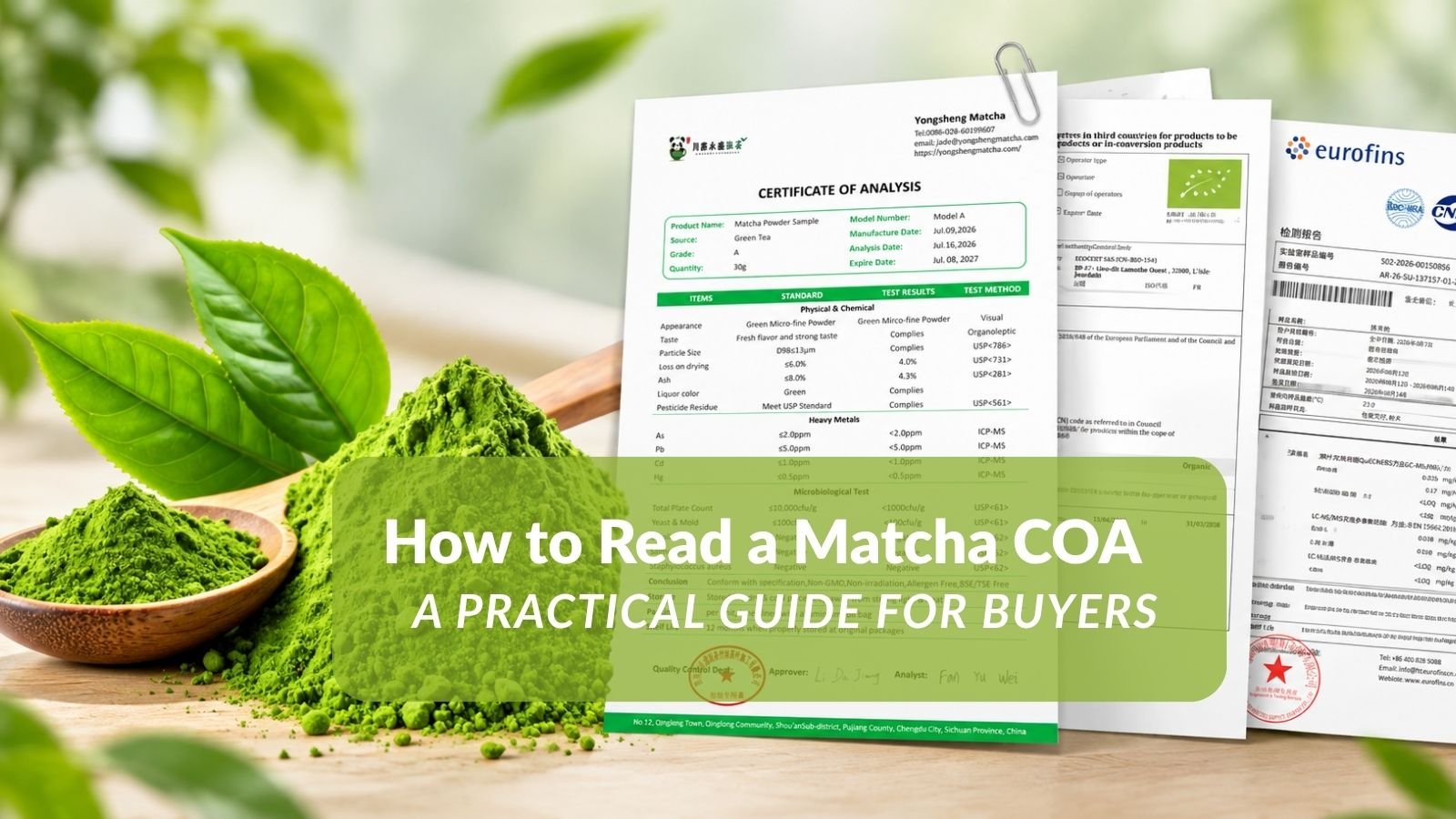
- Certificate of Analysis (COA)
- Microbiological testing
- Heavy-metal testing
- Pesticide testing
- Organic certification
- Food-safety certifications
- Other market-specific compliance documents
For U.S. imports, buyers should also understand the applicable FDA food-facility registration, importer, FSVP, labeling, and food-safety requirements rather than treating an FDA registration as a general product approval.
4. MOQ
A supplier's MOQ should be evaluated against your consumption and inventory cycle.
A low unit price is not necessarily a good deal if you cannot realistically use the product before its recommended shelf life.
Ask about both the normal MOQ and the trial-order MOQ.
5. Lead Time
Do not compare suppliers based only on the production time shown on a quotation.
Ask how long the complete process takes:
Production → packing → export → transportation → customs → delivery
Actual transit time varies by origin, destination, shipping method, season, and customs conditions. Build enough buffer into your inventory plan to avoid buying solely on an optimistic transit estimate.
6. Consistency
Matcha is an agricultural product, so some variation between production lots is normal.
Instead of asking for an arbitrary percentage of "batch variation," ask the supplier:
- How are different lots evaluated?
- Are lots blended to maintain consistency?
- Can you receive a pre-shipment sample?
- Are COAs provided for each lot?
- How are specification deviations handled?
This gives you a more useful picture of consistency than a single percentage.
7. Landed Cost
The lowest quoted price is not necessarily the lowest purchasing cost.
Your landed cost may include:
Product price + packaging + freight + duties + customs fees + testing + other applicable costs
Incoterms also matter. For example, a quotation on an FOB basis should not be compared directly with a delivered-price quotation without accounting for the additional costs and responsibilities.
A weighted scorecard across these criteria can make supplier comparisons more objective. For a more detailed framework, see our How to Evaluate a Matcha Supplier for Bulk Purchase guide.
Bulk, Wholesale, or Both?
The right purchasing model depends primarily on what you plan to do with the matcha.
You use matcha in your own products
If you are a café, bakery, beverage manufacturer, or other food business, you will usually care most about:
- Consistent specifications
- Suitable packaging
- Reliable supply
- Reasonable MOQ
- Landed cost
- Documentation
Bulk packaging may be the most practical format, while the purchasing relationship may still be wholesale.
You resell matcha
If you are a retailer or distributor, you may need:
- Retail-ready packaging
- Multiple grades or SKUs
- Product documentation
- Private-label options
- Flexible order quantities
In this case, wholesale purchasing does not necessarily mean buying large bulk bags.
You are building your own matcha brand
Private label can combine both models.
One common approach is to purchase bulk matcha and have it packed under your own brand. Depending on the supplier, you may also be able to specify:
- Blend
- Grade or application
- Packaging format
- Package size
- Label requirements
Custom specifications and packaging may require higher MOQs and additional development.
See our private label matcha options for more information.
You need both
The two models can also be combined.
For example, a café chain might purchase bulk matcha for beverages while purchasing retail-ready tins for its stores. In this situation, working with one supplier may simplify purchasing, documentation, and product consistency.
Bulk vs Wholesale Matcha: FAQ
Is bulk matcha the same as wholesale matcha?
No.
Bulk generally describes quantity or packaging, while wholesale describes the B2B purchasing relationship and pricing structure.
A buyer can purchase a bulk 1 kg bag without a formal wholesale relationship, or purchase wholesale quantities of smaller retail-ready packages.
Is wholesale matcha cheaper?
Wholesale purchasing often provides a lower per-unit price than consumer retail purchasing, but there is no universal wholesale discount.
The actual price depends on origin, product specifications, quantity, packaging, supplier, shipping terms, and other commercial conditions.
The right comparison is therefore landed cost per usable kilogram, not simply the advertised price.
What is the MOQ for bulk matcha?
There is no universal MOQ for bulk matcha.
It varies by supplier, product, packaging, origin, and whether you are purchasing existing stock or requesting custom production.
Ask for both the standard MOQ and the smallest available trial order before committing to a supplier.
Can I buy bulk matcha for private label?
Yes.
One common private-label model is to purchase bulk matcha and have it packed under your own brand.
Private-label requirements can vary significantly. Stock packaging may allow smaller orders, while custom packaging, custom blends, and custom specifications may require larger MOQs.
Can I buy bulk matcha directly from a manufacturer?
Yes, but buying direct is not automatically the best option for every business.
Direct purchasing may offer greater supply-chain visibility and potentially reduce intermediary costs. However, it may also involve:
- Larger MOQs
- Production planning
- Export documentation
- Import compliance
- Freight and customs
- Inventory management
- Communication across languages and time zones
The right question is not simply "manufacturer or reseller?" but which supply model gives your business the best combination of price, quality, traceability, flexibility, and supply reliability?
The Bottom Line
Bulk is primarily about quantity and packaging. Wholesale is primarily about the B2B purchasing relationship and pricing structure.
The two can overlap, but they are not the same thing.
Before placing a bulk matcha order:
- Estimate your actual consumption.
- Match the order size to your inventory cycle.
- Compare the product specification, not just the grade name.
- Verify origin and batch traceability.
- Request relevant testing and documentation.
- Compare landed cost rather than sticker price.
- Confirm MOQ, lead time, and storage requirements.
The best supplier is not necessarily the one offering the lowest price or largest volume discount. It is the supplier whose product, documentation, purchasing terms, and supply capability fit your actual business needs.
Request free samples with batch COAs and spec sheets: 10 to 500 g samples drawn from production lots, with a reply within 12 hours. Pilot orders and larger-volume supply are available for commercial buyers.