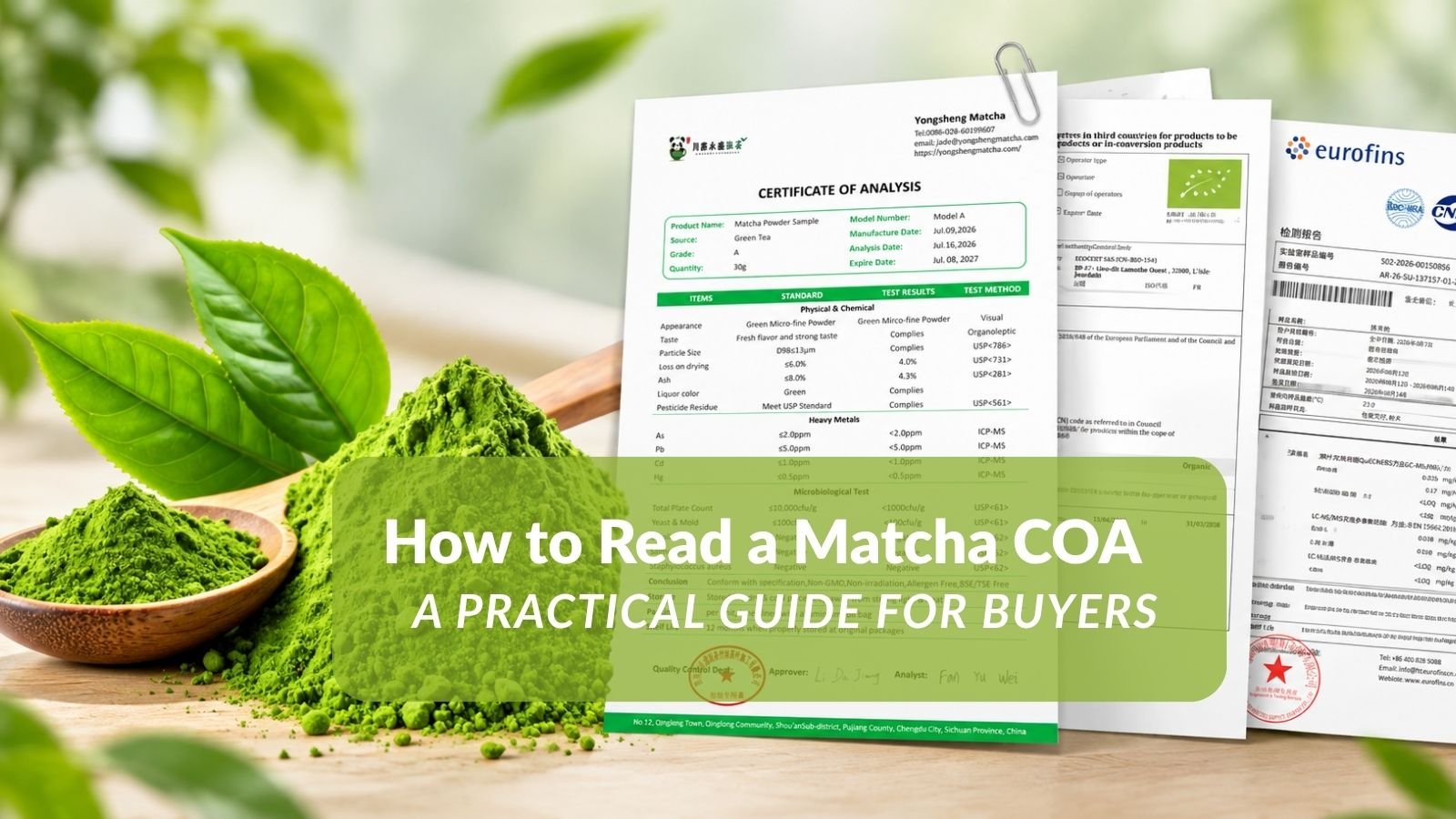
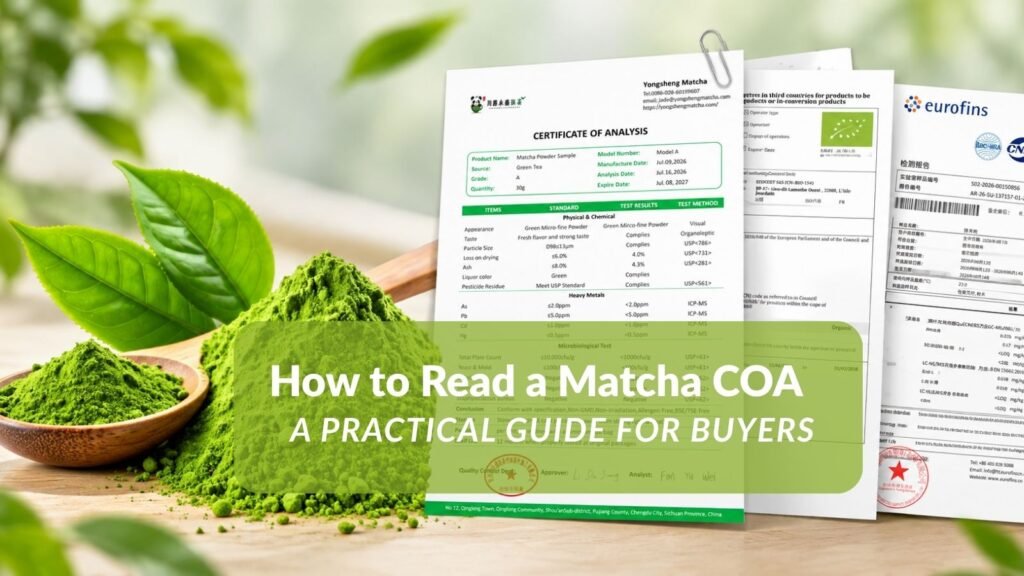
A Certificate of Analysis (COA) is one of the most important documents in a matcha purchase. It records what was tested in a specific batch, and the results. But a COA that says "Pass" is not the same as a COA that proves quality — you have to read the data. This guide walks through a real matcha COA from our own sample kit, then closes with a checklist and seven red flags for every order.
Start by Checking Whether the COA Actually Matches Your Batch
Before you interpret a single number, confirm the document is traceable to the product and the batch you are buying. Here is the header of a real matcha COA, the kind that accompanies our sample kits:

Check it field by field:
- Supplier information — does the company match the exporter you are contracting with?
- Product name, model, and grade — does it match what you ordered, down to the grade and model?
- Manufacture date, analysis date, and expiry date — the dates should be consistent with each other and with the goods you are receiving.
- Quantity or lot information — if provided, check that it is consistent with the shipment records.
Then find what ties the document to a specific batch. Some COAs carry a dedicated batch or lot number; others identify the batch by a model name combined with the manufacture date, as this one does. Either is fine, as long as it matches your order documents — invoice, labels, packing list. A COA tied to no batch could belong to any batch — good, old, or template.
Whatever the style, one question matters most:
Is this COA actually for the matcha I'm buying?
The rest of this guide only matters if the answer is yes.
Learn How to Read the Numbers on a Matcha COA
With the header verified, move to the results. Here is the physical and chemical block of the same COA:

Most matcha COAs present results as a table; every row reads the same way. A typical row has four elements:
Test → Specification → Result → Method
The specification is the rule — the limit or description the product must meet. The result is the measurement for this batch. Units usually live inside these columns, though some layouts give them their own column. An illustrative example with typical values:
| Test | Specification | Result | Method |
|---|---|---|---|
| Lead | ≤ 1.0 mg/kg | 0.12 mg/kg | ICP-MS |
| Moisture | ≤ 7.0% | 4.2% | AOAC |
| Salmonella | Absent / 25 g | ND | ISO |
Read the rows together. A quantified result against a numerical specification is the clearest format — in the lead row, 0.12 against ≤ 1.0, with a method, so the margin is visible. Salmonella shows the pathogen style: specification "Absent / 25 g," result "ND" — not detected. Descriptive specifications also appear — an appearance or taste row, reported as "Complies." On a sensory line that is normal; on a safety line, ask for the values behind it.
The vocabulary you will meet:
- ND — not zero: the substance was not detected above the method's stated detection limit; the exact meaning depends on the laboratory's reporting convention.
- < LOQ — the result is below the laboratory's limit of quantification, so the substance cannot be reliably quantified at that level.
- Units — ppm and mg/kg are equivalent, but never compare a ppm result against a percentage specification; microbiology counts come in cfu/g.
And read the method column every time — "ICP-MS" for heavy metals, and methods such as ISO 1573 or AOAC 925.19 for loss on drying in tea. Loss on drying is a practical moisture-related measure, but it is not identical to a water-specific determination. The method tells you what was measured, and how sensitively. Never read the Result alone — specification, unit, and method are a set.
Focus on the Three Safety Areas: Heavy Metals, Pesticides & Microbiology
The safety block is where a COA earns its keep — here is the same COA's safety block, and how to read each part:

Heavy metals
Matcha is consumed as powdered leaf, not an infusion discarded after brewing, so contaminants in the leaf can contribute directly to dietary exposure. A robust matcha COA will often include four commonly monitored elements, as this one does: lead (Pb), cadmium (Cd), arsenic (As), and mercury (Hg). Here, they are measured by ICP-MS.
How results are written matters: a quantified figure against its limit tells you the most; "below the limit" or "ND" are also common reporting styles, but they tell you less about the actual concentration — especially when the detection or quantification limit is not shown.
Most buyers memorize one "global standard." There isn't one. Limits differ between pharmacopoeia-style specifications, each market's food law, and your own customer's requirements — two COAs can show different lead limits, both correct. Organic certification does not exempt anyone: heavy metals come from soil, water, and air, not agricultural chemicals.
So don't ask "is this value good?" Ask: what limit applies in your market, and does the result sit comfortably below it?
Pesticide residues
Many COAs, this one included, summarize pesticides in a single line: complies with a named standard. A named standard tells you which regulatory framework the result was assessed against, but a summary "Complies" line does not show the individual residues or reporting limits. Establish three things:
- What was tested. How many compounds, against which list? Serious panels cover dozens to hundreds.
- MRL — maximum residue limit. MRLs are market-specific — the EU maintains its own MRL legislation: compare the result with the limits that apply to your destination market and intended use.
- ND and LOQ. "Not detected" is meaningful only when the detection or reporting limit is stated.
If you sell into multiple markets, confirm the panel and specifications cover each market's requirements — tell your supplier where the matcha will be sold.
Microbiology
Common parameters include total plate count (cfu/g), yeast & mold (cfu/g), E. coli, and Salmonella, though panels vary by market and application; this one adds Staphylococcus aureus. For hygiene indicators, compare the count with the applicable limit and mind the margin — a bare pass is not the same as a comfortably lower result. For pathogens such as Salmonella, the criterion is typically absence within the specified test sample — always check the applicable specification and sampling plan. Keep the intended application in mind: microbiological requirements differ with formulation, processing, water activity, shelf life, and whether the final product receives a kill step. Depending on the target market, product, and risk assessment, buyers may also require additional testing for contaminants such as mycotoxins or radionuclides.
One thing safety results will never tell you: whether the matcha tastes good. Safety answers whether the batch meets applicable requirements — not whether it is delicious or premium.
What Can a COA Tell You About Matcha Quality—and What Can't It?
The COA closes with a conclusion and practical details, its final part:

Read that line carefully — the most instructive sentence on the document: "Conform with specification." It says the batch met the tested criteria, nothing more. The storage and shelf-life notes are useful, but no conclusion line tells you how this matcha performs in your latte.
Beyond safety, COAs often carry quality parameters — you saw them in Part 2: loss on drying, a practical moisture-related specification, for shelf life and handling; particle size — typically a mesh range or an equivalent measured diameter — which shapes mouthfeel, latte suspension, and bakery performance; color, descriptive or measured L*a*b*; ash; and sometimes caffeine and other values. These read the same way as safety results: specification, result, unit, method.
But here is the most important idea in this guide: a COA does not tell the whole quality story. A passing COA cannot alone prove:
- that a matcha deserves the "ceremonial grade" label
- how it tastes, or how fresh its aroma is
- how it performs in a latte or in baking
- that future batches will be consistent
- where the leaves were grown
- that the quality is "superior"
Two reasons why. First, "ceremonial grade" is not a regulated matcha grade — it is a market term whose meaning varies by supplier. Second, taste, aroma, and application performance are sensory and functional outcomes; no standard COA panel measures them. Even a "Taste: Complies" line is the producer's own check — no substitute for tasting the batch yourself. And a COA covers one batch only — year-long consistency takes multiple COAs and a supplier you can talk to.
Each procurement tool answers a different question:
| Tool | What it answers |
|---|---|
| COA | Did this batch meet the tested criteria? |
| Specification | What should this product be? |
| Sample evaluation | Does it actually work for my application? |
| Certification | Does it meet a defined certification standard? |
Use all four: agree the specification before the first order, verify each batch against its COA, evaluate a sample whenever your application or season changes, and let certifications cover what testing cannot see. Buyers who lean on the COA alone are the ones surprised when a "passing" batch disappoints.
A Matcha Buyer's COA Checklist
You now know how to read the document. This final section is the working version — the checks to run on every order, and the signs that should stop one. Adapt it to your market and application, and make it part of your receiving procedure.
10-Point Matcha Buying Checklist
Before approving a batch, confirm:
☐ Product name and batch identifier match your order
☐ Test date is recent and consistent with the batch
☐ Laboratory is identifiable
☐ Actual results are shown — not just "Pass"
☐ The heavy-metal panel covers the elements required for your market
☐ Pesticide testing scope is clear
☐ Microbiological results are included
☐ Units and test methods are stated
☐ Results are compared against applicable limits
☐ A sample has been evaluated for your application
Once they become routine, these ten checks take only a few minutes — and they catch the problems most expensive to discover after the goods arrive.
7 Red Flags to Watch For
Any single red flag below is a reason to hold the order and ask before the goods ship — not necessarily to walk away, but until the answer arrives:
- No batch identifier — nothing ties the document to the batch you are buying
- Product name doesn't match your order
- Only "Pass," with no actual values behind it
- No test method given — results cannot be compared and sensitivity is unknown
- Unclear laboratory — no named testing entity
- "ND" with no detection or quantification limit — the sensitivity of the test is unknown
- An old COA presented for a new batch — it may not represent the goods you are receiving
Matcha COA FAQs
Is a COA the same as an organic certificate?
No. A COA is a batch-level test record: it shows what one batch was tested for, and the results. An organic certificate shows that an operation has been certified under a defined organic standard, such as USDA, EU, or JAS. The certification process involves review and inspection against that standard. They answer different questions: the certificate documents the operation's organic certification status, while the COA records the tested characteristics of a particular batch.
The COA only says "Pass." Is that enough?
It is the weakest form of reporting. A verdict without values cannot be compared across suppliers, tracked batch to batch, or audited later. Ask for the actual results with their limits, units, and test methods — a supplier who tests properly can produce them.
Can one COA cover multiple shipments?
Sometimes. A COA normally applies to a specific batch or defined lot, not automatically to every shipment from the same supplier. If multiple shipments come from the same defined lot, one COA may cover them if the lot remains clearly traceable and the applicable requirements allow it. If the shipments come from different production batches, each batch should have its own test record. The document follows the batch, not the customer.
My retest result differs from the supplier's COA. What now?
Do not assume bad faith first: results can differ because of the method, the sample preparation, or which sample was tested. Compare test methods and reporting limits side by side, and ask the supplier to do the same; where the gap matters, an independent test on a retained or arbitration sample settles it.
Is in-house QC testing acceptable, or do I need a third-party lab?
Both are legitimate, and they do different jobs: in-house QC supports the producer's own release decisions, while a third-party lab adds independence. Some markets, customers, or specifications may require or prefer third-party testing — and with a new supplier, asking for one independent verification is reasonable.
A COA is a batch-level test record — not a quality verdict. Read the header before the numbers, read specifications and methods alongside results, judge safety against the limits that apply in your market, and let a sample tell you the rest.
Yongsheng Matcha operates under an FSSC 22000-certified food safety management system and an FDA-registered food facility, and every batch we ship is tested and documented. Practice on the real thing: request a sample — it arrives with its COA, so you can run every check in this guide on a live document. Contact us.